Presentation Summaries
1
"Industrial AI is not only about detecting anomalies — it is about understanding materials, processes, and uncertainty."

A comprehensive overview of Safran's AI research programme for non-destructive testing (NDT) and material characterisation of aerospace composites. Vandoni presented the PERCIVAL lab's portfolio spanning autonomous systems, 3D perception, simulation & transfer learning, and robust AI. A central contribution is the Safran-MNIST dataset — released through the DAGECC competition — comprising Safran-MNIST-D (~2,100 images, 10 digit classes) and the larger Safran-MNIST-DLS (~13,600 images, 32 classes of digits, letters, and symbols), all captured on real aerospace parts with diverse backgrounds, noise, blur, and class imbalance. The talk also covered learning under noisy label conditions via imprecise probability theory and iterative label correction, achieving a 53 % accuracy gain over noise-ignorant baselines. Key industrial application: AI inspection of 3D woven composite LEAP fan blades where certification requires equivalency test protocols.
Safran-MNIST-DLS: 13,600 images across 32 alphanumeric + symbol classes
Noisy label correction achieves +53% gain at 40% label noise
Future: AI agents integrated into aerospace certification workflows
Collaborations: Mines Paris, CentraleSupélec, Inria, Paris-Saclay, ENSTA
2
"Intelligent screening is not just detection — it is understanding what a threat looks like before you've ever seen one."

Rapiscan Systems presented their end-to-end portfolio for physical security screening, targeting customs, borders, aviation, military, law enforcement, event security, and critical infrastructure. The presentation demonstrated how combinational transmission and backscatter X-ray imaging reveals concealed threats invisible to any single modality — backscatter uniquely highlights organic materials hidden in undercarriages, panels, and door linings. Colour-coded CT imagery was shown to enable material discrimination and threat localisation inside cargo containers and vehicles. The AI/ML analytics layer assists human adjudication, while synthetic data generation and smart annotation strategies address the chronic challenge of data scarcity and class imbalance in security imagery. Metadata integration (license plates, container IDs, shipment records) was highlighted as a key enabler for faster, more informed decision-making.
Combinational transmission + backscatter reveals threats missed by single modality
CT provides full 3D material discrimination inside cargo
AI/ML analytics augments human adjudicators, not replaces them
Synthetic data and smart annotation address data scarcity
3
"Safety sensing is a scene-understanding problem — and HSI is the missing material cue."

In one of the most technically ambitious presentations of the day, Song argued that conventional safety sensing approaches all have blind spots: human inspection is contact-dependent and risky for unknown hazards; point sensors only cover predefined targets; RGB cameras are visual-cue dependent. Hyperspectral imaging (HSI) captures a full spectral cube at every pixel, providing wavelength-dependent material signatures that make visually identical but chemically different substances distinguishable. This is critical in semiconductor fabs where solid, liquid, and gaseous hazardous materials coexist. The core bottleneck identified is observability — real manufacturing conditions introduce illumination shifts, heterogeneous backgrounds, changing geometry, and material mixing, producing unstable spectral responses. Song called for observability-aware HSI systems that reliably monitor hazardous materials in dynamic factory environments.
HSI provides spectral fingerprints invisible to RGB cameras
Observability is the core bottleneck: illumination, geometry, mixing
AI is necessary because HSI signals are high-dimensional and contextual
Target: real-time material monitoring in semiconductor fabs
4
"Not just how many — but how many are broken, cracked, or bent. FALCON counts with context."

Cho introduced a novel task called fine-grained industrial object counting, which goes beyond simple object counting to simultaneously localise and classify components by their specific defect attributes (e.g., "15 normal plastic caps" and "3 broken plastic caps" in the same scene). To benchmark this task, the team released the FIOC dataset (1,000 images, 10 object classes, 41 defect attributes) covering components like fuses, bolts, potentiometers, and plastic caps. The proposed FALCON framework is a two-stage pipeline: Stage 1 uses SAM 3 for class-agnostic region proposal and ROI cropping; Stage 2 performs fine-grained vision-language alignment using PE-Core with CoOp, aligning each cropped region to its attribute description via learnable text embeddings. This decoupling allows the system to handle open-vocabulary attribute descriptions without retraining.
FIOC: first benchmark pairing instance counts with fine-grained defect descriptions
SAM 3 for class-agnostic proposal; PE-Core + CoOp for attribute alignment
Open-vocabulary: handles attribute descriptions not seen during training
Future: more robust localisation and FIOC dataset extension
5
"You do not need target-object images to start visual inspection."

A compelling answer to the question: can a pure visual model inspect objects it has never seen? Existing zero-shot anomaly detection methods rely on CLIP-style text-image alignment, but this forces the use of text backbones and limits the use of purely visual foundation models (VFMs). The team identified two root causes for VFMs lagging: limited data diversity in anomaly datasets and overly shallow adaptation that keeps backbones intact. AnomalyVFM addresses this by using LoRA adapters inside transformer attention layers (Fix #2: adapt the VFM internally), updating visual representations rather than only the final prediction head. The result is a next-generation foundation model for anomaly detection that generalises to unseen object categories at test time — a critical capability for industrial lines where new parts are continuously introduced.
Zero-shot: test-time object category never seen during training
LoRA inside attention: updates visual features, not just the output head
Removes dependence on text/CLIP backbones entirely
Targets scratches, stains, cracks — defects as small as a few pixels
6
"Labels without evidence are opinions. EviInspect demands proof."

The Hellas team tackled a fundamental but underappreciated problem: before AI can be trusted for safety-critical inspection, the datasets used to train and evaluate it must have evidence-grounded labels. Hazard, severity, and risk labels are not raw pixel observations — they are derived from domain rules and visual cues together. Without recording the evidence chain, labels are inconsistent, unauditable, and irreproducible. EviInspect introduces a dataset-first framework with three contributions: (1) a staged pipeline formalised as (I, c, D) → DR → E → y, where a label y is assigned only when evidence E is sufficient and decisions are reproducible; (2) FOD-A-H, an FAA-grounded Foreign Object Debris benchmark with hazard and size annotations; and (3) an evaluation protocol measuring both correct prediction and correct abstention under insufficient evidence. Findings show a significant gap between current VLM reasoning ability and the demands of safety-critical inspection.
FOD-A-H: FAA-grounded benchmark with hazard severity and size labels
Labels accepted only when evidence is sufficient and decisions reproducible
VLMs fail to use retrieved evidence reliably — retrieval ≠ safety
Evaluation rewards abstention when evidence is insufficient
7
"Precision imaging alignment + scale-aware YOLO = a gear inspection system that actually converges."

Wang et al. presented a full end-to-end pipeline for inspecting powder-metallurgy gear surfaces — a domain where defects like cracks, collapse, convex deformation, and surface contamination can be sub-millimetre and visually subtle. The system's key insight is that consistent side-view alignment at image acquisition dramatically reduces annotation burden and enables faster model convergence (positioned images converge significantly faster than non-positioned ones). A four-tier ROI labelling strategy and Multi-Attention YOLOv8 variants specialised for different defect types handle the multi-scale detection challenge. The pipeline closes the loop with single-gear defect maps and cross-workspace defect maps for manufacturing traceability and root-cause analysis. Dataset: 4,627 images across 6 defect categories (Collapse, Color, Convex, Crack, Deform, Dust) split 7:2:1.
Side-view alignment eliminates perspective variance, cuts annotation cost
Multi-Attention YOLOv8: separate detection heads per defect scale
Defect maps enable process control and cross-workspace drift analysis
Validated on spur gear and helical gear workpieces
8
"When defects occupy just 1.5% of the image, representation quality is everything."

Saparova and Lee addressed one of the hardest practical problems in industrial inspection: detecting weld defects that are visually subtle, low-contrast, extremely small (~1.5% image area), and severely underrepresented in training data. Standard classifiers fail catastrophically under such conditions. Their proposed representation-driven framework combines three complementary components: (1) Virtual Flaw augmentation to synthetically generate minority-class examples; (2) class-conditional supervised contrastive learning to pull same-class features together and push different-class features apart in embedding space; and (3) attention-enhanced feature extraction to focus the network on relevant defect regions. The results speak clearly: the proposed method achieves AUROC 0.907, AP 0.913, AUPRC 0.913 — dramatically outperforming UniNet (0.732), BGAD (0.720), and SupCon (0.566) across all metrics.
AUROC 0.907 vs best baseline 0.732 — a 17-point improvement
Virtual Flaw augmentation generates synthetic minority-class defects
Class-conditional contrastive loss structures embedding space explicitly
Tuned via Optuna hyperparameter optimisation for fair comparison
9
"The system acts as its own training data generation engine before it ever reaches the factory floor."

Afrasiabi presented Boeing's patented (US 12,530,856) approach to manufacturing inspection: Self-Validating Augmented Reality, which shifts the burden of proof from the human inspector to the AI system. The dual-phase architecture is the key innovation: in the training phase, a composite image generator fuses CAD images with captured factory images to produce unlimited labelled training data without sending engineers to the shop floor; in the inference phase, a neural network latching classifier determines pass/fail states (latched / not latched) in real time via an AR display. This evolution — from human judgment (past) → AR-guided human judgment (present) → AI classification (proposed) — reduces cognitive load from high to minimal and scales exponentially rather than linearly. The system is hardware-agnostic, deployable on AR headsets, tablets, or robotic arms with a human-in-the-loop validation gateway.
Composite image generator: CAD + real captures = unlimited labelled data
Cognitive load: High (human) → Minimal (AI); scalability: Linear → Exponential
Hardware-agnostic: AR headsets, tablets, robotic arms
Patented technology actively deployed at Boeing manufacturing
★
"Production failure is not a model problem. It is an integration, label, position, and generalization problem. Compounded at scale."
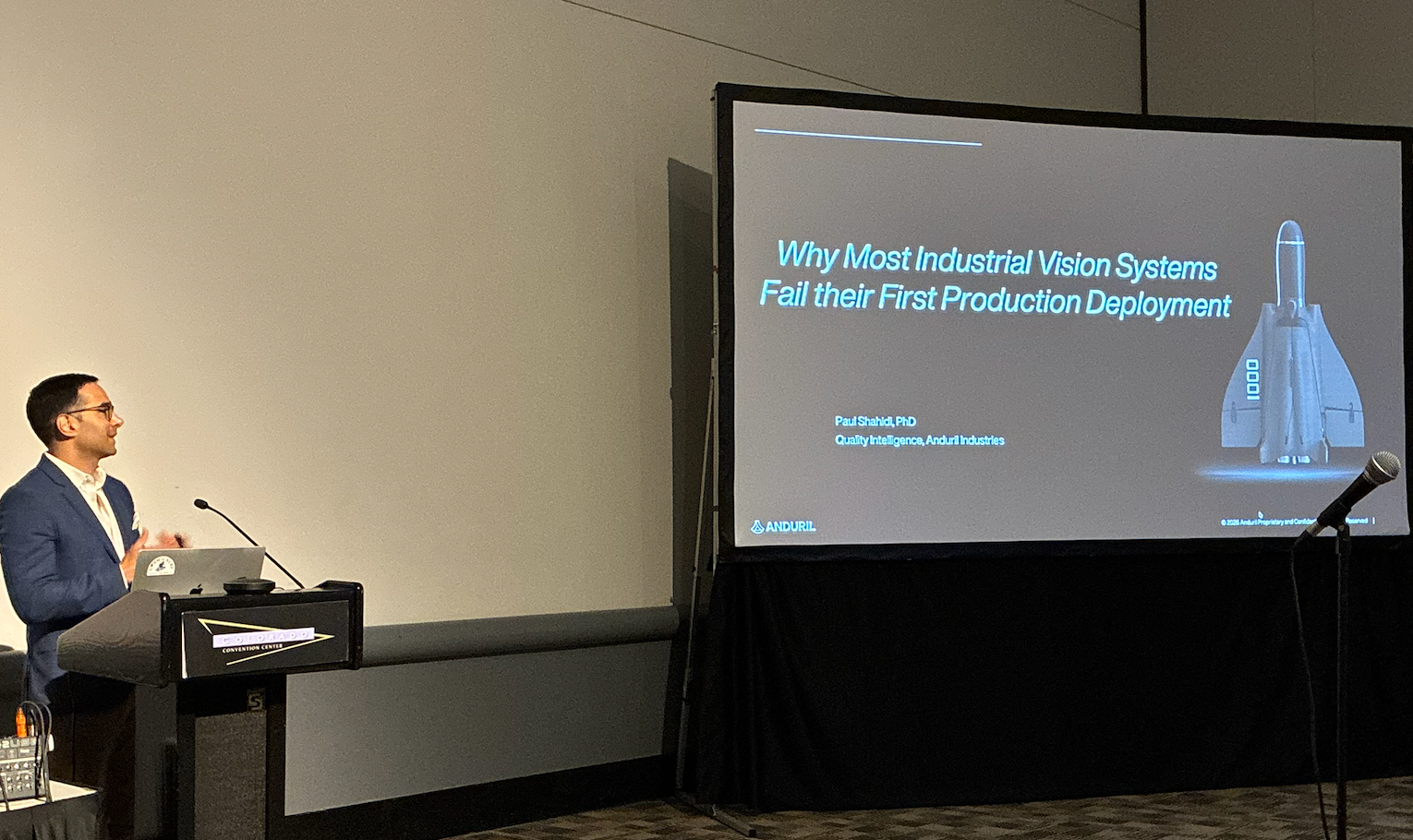
Shahidi presented a practitioner's taxonomy of why vision models that perform well on benchmarks routinely fail their first shopfloor deployment. The framework organizes failure across four compounding layers. Observability: optical blind spots and surface geometries the imaging hardware physically cannot resolve. The exponential cost of pushing coverage from 95% to 99.5% through additional stations and modalities. Label integrity: production defect taxonomies are organized by root cause, not visual appearance, creating systematic label noise when visually identical defects carry different annotations. Position-dependent accuracy: the cost asymmetry between false positives and false negatives shifts dramatically depending on where inspection sits in the assembly sequence. Upstream stations optimize for recall; downstream stations must jointly optimize recall and precision under fundamentally different economics. Closing the loop: detection alone delivers limited value until architecturally connected to root-cause attribution and corrective action, transforming inspection from a quality gate into a quality intelligence system. These challenges compound at scale: models that work at one factory regularly fail at another due to tolerance variation, material differences, and hardware configuration drift.
Observability ceiling: 95% → 99.5% surface coverage costs more than the first 95% combined
Label noise is structural. Root-cause taxonomies create ambiguity no annotation effort resolves.
Positional cost asymmetry demands different operating points upstream vs. downstream
Foundation models and zero-shot detection won't reach production until cross-site generalization is solved